Why We Built Quorvex AI
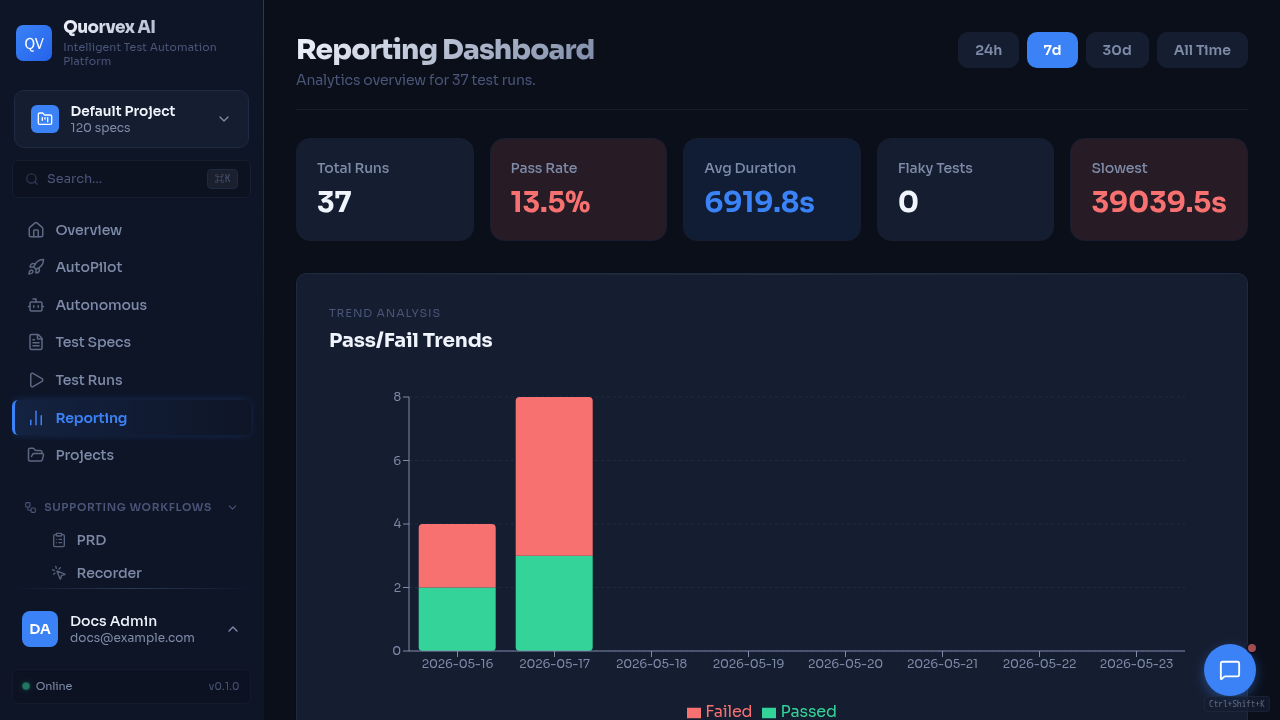
Quorvex dashboard overview showing the product workflow.
The Problem
Writing end-to-end tests is slow, maintaining them is painful, and most teams don't have enough QA engineers. When UI changes break selectors, someone has to manually hunt down and fix every affected test. This creates a cycle where teams either spend too much time on test maintenance or give up on comprehensive test coverage entirely.
AI-powered testing tools have started to address this, but they come with trade-offs:
- No-code platforms (testRigor, Mabl) optimize for plain-English hosted authoring, but the executable system is still the vendor runtime rather than standard Playwright code your team owns.
- Runtime-first AI tools (Shortest, ZeroStep) keep AI in the execution path. In a CI/CD pipeline running tests on every commit, that can add cost and variability.
- Managed QA SaaS products (Octomind) can be excellent for hosted Playwright E2E coverage, but the operating plane, run history, workers, and account model live primarily in the vendor platform.
- Most testing stacks are fragmented. Teams still end up stitching together separate tools for API testing, load testing, security scanning, database checks, LLM evaluation, requirements, traceability, and PR quality gates.
Our Approach
Quorvex AI takes a different path:
Generate once, run forever. The AI writes standard Playwright TypeScript code that you own. Once generated, tests run natively with zero AI cost -- just like hand-written tests, but created in seconds instead of hours.
Self-healing without AI at runtime. When tests break due to UI changes, the self-healing pipeline detects failures and regenerates the affected code. The fixed tests are again standard Playwright code that runs natively.
One platform, multiple testing domains. UI testing is just the starting point. API testing, load testing (K6), security scanning (ZAP + Nuclei), database quality checks, mobile smoke flows, LLM evaluation, requirements, RTM, coverage, schedules, and PR quality gates are all built in.
Self-hosted and open source. Your data stays on your infrastructure. No vendor lock-in, no usage-based pricing, no data sovereignty concerns. The MIT license means you can use it however you want.
Who It's For
- QA engineers who want to write tests faster without sacrificing control over the generated code
- Developers who need comprehensive test coverage without becoming testing experts
- Product managers who want to turn PRDs directly into test suites
- Teams who need self-hosted deployment for compliance or security reasons
- Startups who need enterprise-grade testing without enterprise-grade budgets
The Vision
Testing should be as easy as describing what you want to verify. Not easier -- we're not hiding complexity behind a black box. We're using AI where it adds the most value (understanding intent, exploring applications, writing code) and getting out of the way for everything else (running tests, reporting results, integrating with CI/CD).
The generated code is yours. Read it, modify it, check it into version control, run it in any Playwright-compatible environment. The AI is a tool, not a dependency.