Temporal Orchestration
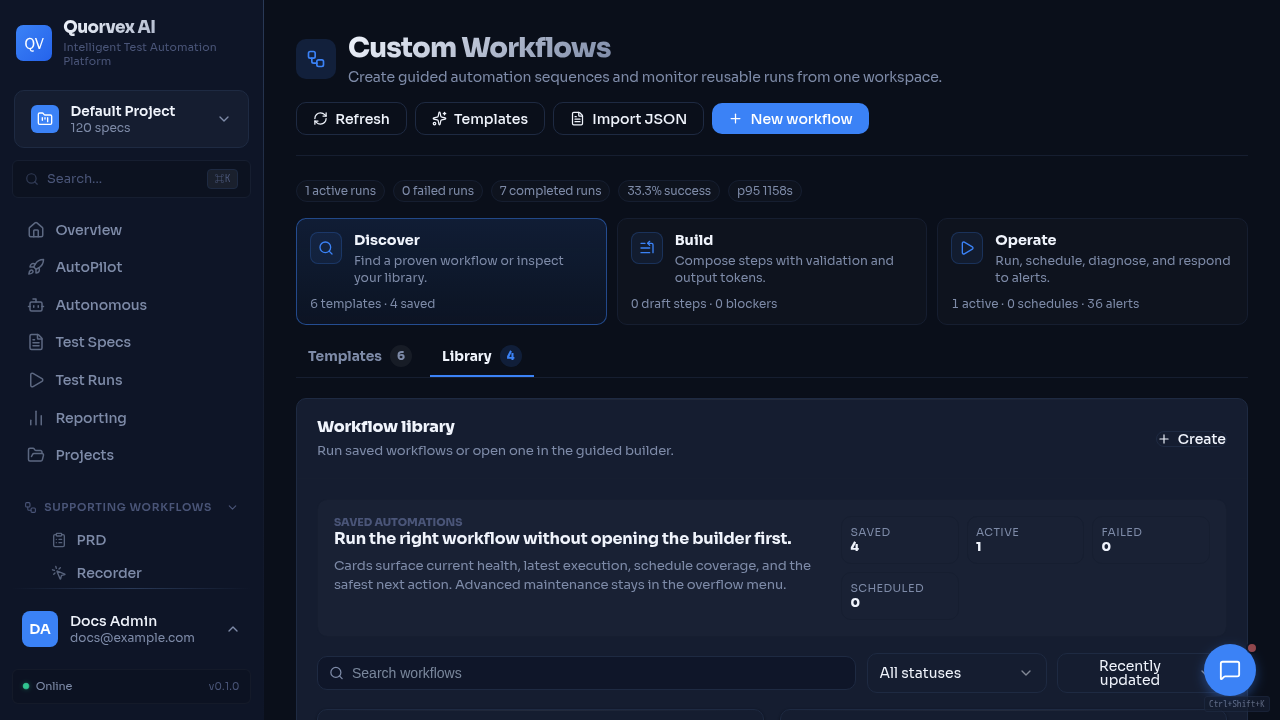
Workflow monitor showing orchestration and workflow diagnostics.
How durable Temporal workflows coordinate autonomous missions, custom workflows, standalone agent runs, and domain background jobs.
Why Temporal Is Used
Autonomous missions, custom workflows, standalone agent runs, and domain jobs need durable control flow: pause, resume, cancellation, retries, status recovery, and long gaps between iterations. Temporal stores workflow history and lets the backend reconnect to workflow state after process restarts.
The database remains the product record. Temporal is the durable execution engine. API handlers start and signal Temporal workflows, while activities read and update database rows.
graph TD
  A["API request"] --> B["Temporal client"]
  B --> C["Temporal workflow"]
  C --> D["Activity"]
  D --> E["Database"]
  E --> F["Dashboard status"]
  B --> G["Signal: pause, resume, cancel"]
  G --> C
Workflow Families
| Workflow | Source | Task queue | Purpose |
|---|---|---|---|
AutonomousMissionWorkflow | orchestrator/workflows/autonomous_mission_workflow.py | settings.temporal_task_queue | Long-lived mission iterations, approvals, budget checks, and next-run delay |
CustomWorkflowRun | orchestrator/workflows/custom_workflow_temporal.py | settings.temporal_workflow_task_queue | Durable execution of saved workflow definitions and persisted run steps |
AgentRunWorkflow | orchestrator/workflows/agent_run_workflow.py | settings.temporal_workflow_task_queue | Durable execution, retry, and control signals for standalone agent runs |
DomainJobWorkflow | orchestrator/workflows/domain_job_workflow.py | settings.temporal_workflow_task_queue | Durable execution for requirements generation, bulk spec generation, and RTM generation |
Temporal client helpers live in orchestrator/services/temporal_client.py. They create workflow IDs, start workflows, send control signals, and fetch lightweight diagnostics.
Autonomous Missions
An autonomous mission workflow loops until cancelled or completed. Each iteration:
- Updates mission heartbeat.
- Loads current mission policy from the database.
- Pauses when budget or approval limits require human review.
- Creates a mission run row.
- Executes one bounded iteration through activities.
- Completes or fails the mission run.
- Computes the next delay and sleeps or continues as new.
The workflow supports pause, resume, and cancel signals. Activities in orchestrator/services/autonomous_activities.py own database writes, agent work item synchronization, finding creation, and proposal creation.
Custom Workflows
A custom workflow run wraps persisted workflow steps. The Temporal workflow repeatedly asks the workflow runner for the next step, executes it as an activity, and applies recovery semantics when a step fails.
Control signals:
| Signal | Effect |
|---|---|
pause | Sets workflow state to paused and persists the pause reason |
resume | Lets the workflow continue to the next step |
cancel | Marks the run cancelled and stops further step execution |
Step execution remains in orchestrator/services/workflow_runner.py. Temporal provides durability around that runner rather than replacing its validation and persistence model.
Standalone Agent Runs
Standalone agent runs are fail-closed on Temporal. The API creates an AgentRun row and starts AgentRunWorkflow; if Temporal cannot start the workflow, the run is marked failed and the API returns 503 instead of falling back to non-durable background execution.
AgentRunWorkflow records Temporal metadata, runs the persisted agent through an activity, and emits events for scheduling, start, completion, failures, and control actions. Pause, resume, and cancel requests are Temporal signals. New agent runs execute directly inside Temporal activities and do not require the Redis agent queue.
The custom workflow worker process also registers AgentRunWorkflow, so production deployments must run orchestrator.services.custom_workflow_worker for both saved workflow runs and standalone agent runs.
Domain Jobs
Requirements generation, bulk spec generation, and RTM generation now start DomainJobWorkflow instead of FastAPI background tasks. API handlers create a domain_jobs database row, start Temporal, and return workflow metadata. The activity performs the domain work and updates the same row, so polling works even when the API and worker run in separate processes.
The Redis agent queue is legacy/opt-in. Temporal activities execute agent work directly by default; Redis remains useful for non-agent queues such as K6 and for reading historical agent task records.
Activity Boundaries
Activities are the only place where workflow code should perform non-deterministic operations such as database I/O, subprocess execution, API calls, or queue operations. Workflow code should make deterministic decisions from activity results and signals.
This boundary matters because Temporal can replay workflow history. If non-deterministic work leaks into workflow methods, replay can diverge from the original execution.
Failure Handling
Temporal failures and product-level failures are separate:
- Temporal connection failures raise
TemporalUnavailableErrorin client helpers. - Activity retries are controlled by retry policies in workflow modules.
- Product state such as
failed,paused,cancelled, andawaiting_inputis persisted in database models. - Diagnostics can parse Temporal history for custom workflows and standalone agent runs to show activity status, attempts, failures, and timing.