How to Choose a Setup Path
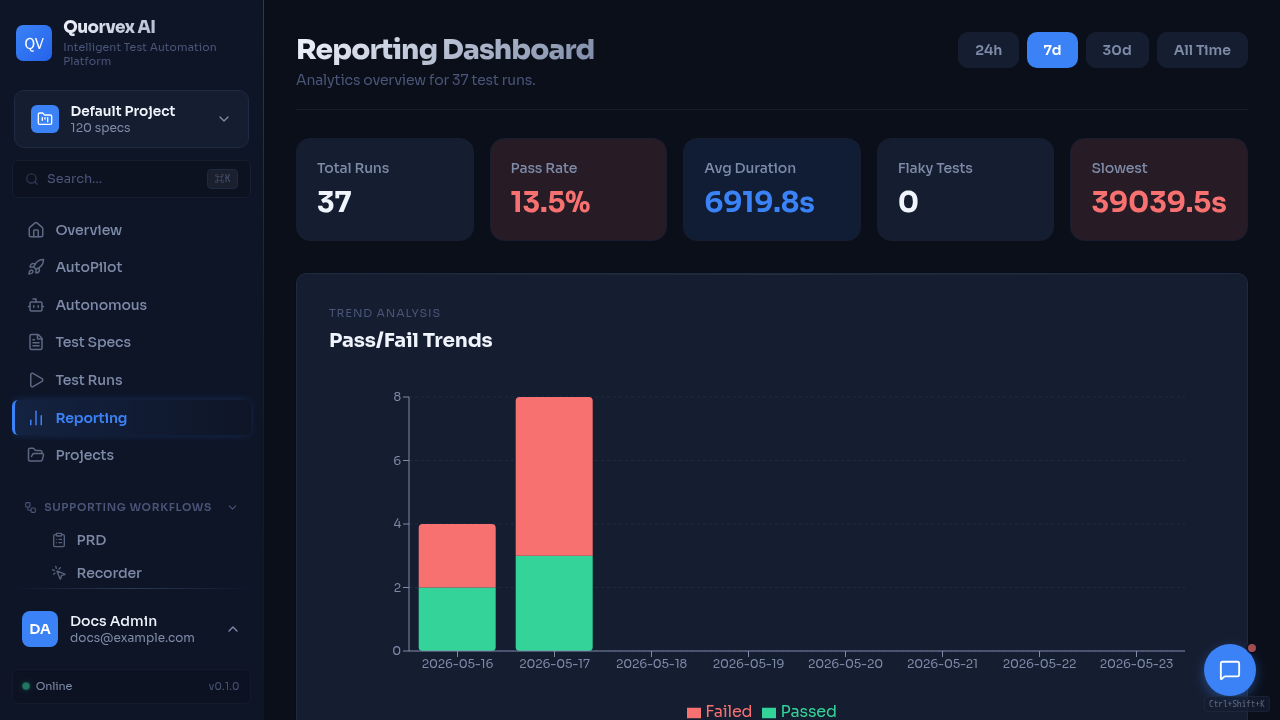
Quorvex dashboard overview after setup is complete.
Choose the smallest setup that matches what you need to prove. You can move from one path to another later without changing how specs are written.
Setup Matrix
| Path | Use when | Database | Main command | Trade-off |
|---|---|---|---|---|
| Evaluator demo | You want the fastest local product trial | SQLite | docker compose -f docker-compose.minimal.yml up -d | Local-only and unsupported for company deployment |
| Contributor dev | You want the dashboard, queues, storage, VNC, and frontend hot reload locally | PostgreSQL | make dev | More RAM and disk usage |
| Production/company | You are running behind company DNS/TLS/nginx in external-nginx mode | PostgreSQL | make start | Requires real secrets, backups, and operational care |
| Repo-managed nginx | You explicitly need the legacy single-host nginx container | PostgreSQL | QUORVEX_ENABLE_REPO_NGINX=1 make prod-up | Guarded; not used for company deployment |
| Browser worker mode | You need more isolated or concurrent browser execution | PostgreSQL | make workers-up | More containers to monitor |
| Kubernetes | You need enterprise scheduling, scaling, and cluster operations | PostgreSQL | make k8s-deploy | Requires Kubernetes ownership |
Recommended Defaults
Start with Evaluator demo if you only want to evaluate the product flow. It is the fastest route to a running dashboard and keeps optional infrastructure out of the way.
Start with Contributor dev if you need to evaluate security scanning, backup storage, VNC live browser viewing, Redis-backed queues, multi-user behavior, or source changes.
Use Local native dev only when you are contributing code or debugging backend/frontend behavior closely. It is the most flexible path, but it asks more of your host machine.
Use Production/company for the first real team deployment. Company deployments are external-nginx mode: company DNS/TLS/nginx proxies to the Compose app, make start starts the app runtime, and the repo-managed nginx container stays disabled unless explicitly requested.
Prerequisites by Path
| Path | Required |
|---|---|
| Evaluator demo | Docker Compose v2, .env with AI provider credentials |
| Contributor dev | Docker Compose v2, 8 GB+ available Docker memory. make dev can create .env.prod from .env.prod.example for local evaluation; edit it with your provider token before real use. |
| Local native dev | Python 3.10+, Node.js 20+, Playwright browsers, optional Docker for PostgreSQL |
| Production/company | Docker Compose v2, .env.prod with rotated secrets, backup location, company nginx/TLS, same-origin browser API routing |
| Kubernetes | kubectl, cluster storage classes, ingress/TLS plan, namespace permissions |
Upgrade Path
- Evaluate with the Minimal Docker evaluator path.
- Switch to Contributor dev when you need queues, storage, VNC, scanners, or source changes.
- Use Production/company external-nginx mode for a team deployment.
- Add browser workers when browser slot contention becomes visible.
- Move to Kubernetes when cluster-level scheduling, policy, or autoscaling is required.
Verification
After starting any setup:
Then open the dashboard at http://localhost:3000 and run a small spec from specs/examples/hello-world.md.
For company deployments, also verify that QUORVEX_PUBLIC_API_URL= and NEXT_PUBLIC_API_URL= are blank, VNC_PUBLIC_WS_URL points to the company /websockify route, and direct 3000, 8001, and 6080 ports are private to the app server or trusted network.