Custom Workflow Contract
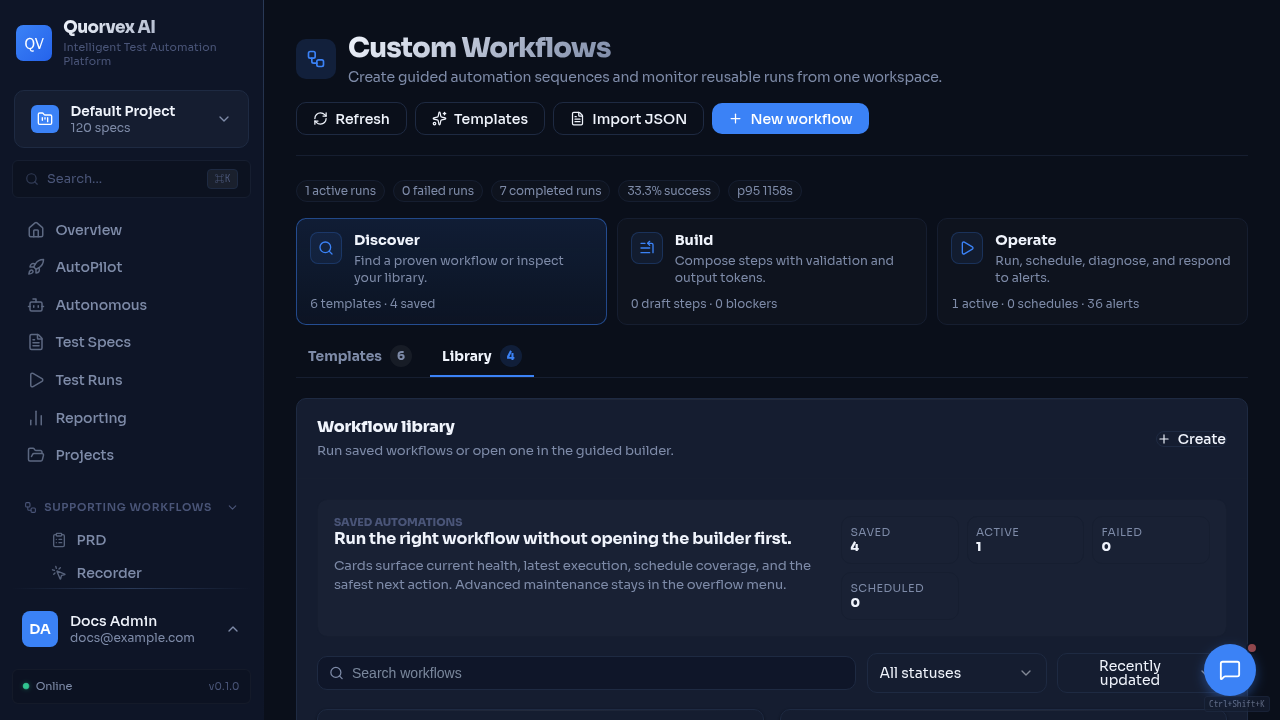
Workflow monitor showing custom workflow definitions and run diagnostics.
Reference for custom workflow definitions, step metadata, output envelopes, and persisted state.
Core Concepts
| Concept | Source | Description |
|---|---|---|
| Workflow definition | WorkflowDefinition | Saved workflow owned by a project |
| Workflow revision | WorkflowDefinitionRevision | Versioned snapshot of a definition |
| Workflow run | WorkflowRun | One execution of a workflow definition |
| Workflow run step | WorkflowRunStep | Persisted execution state for one step |
| Workflow schedule | WorkflowSchedule | Recurring execution configuration |
| Workflow event | WorkflowEvent | Audit and lifecycle event stream |
| Step type | WorkflowStepType | Catalog metadata used by builder, validation, and execution |
Step Definition Shape
Workflow definitions store an ordered list of step objects.
| Field | Type | Notes |
|---|---|---|
key | string | Required. Unique within the workflow; letters, numbers, dashes, and underscores |
type | string | Required. Must match a registered step type |
input | object | Required. Validated against the step type input schema |
label | string | Optional. Defaults to the step type label |
continue_on_error | boolean | Optional. Allows later steps to continue when supported |
recovery_policy | object | Optional. Controls failure handling |
Validation is implemented in orchestrator/services/workflow_runner.py.
Step Type Metadata
Built-in and persisted step types use the same contract.
| Field | Description |
|---|---|
type | Stable step type identifier |
version | Step type version |
label | Human-readable builder label |
description | Short builder description |
category | Builder grouping |
risk_level | Risk label for review and UI messaging |
is_async | Whether the step starts child work that should be waited on |
auto_wait_defaults | Default timeout and polling interval for async waits |
required | Required input keys |
default_input | Builder defaults |
input_schema | JSON Schema for validation |
ui_schema | Dashboard field controls and recommendations |
handler_kind | Handler family, usually builtin for built-ins |
handler_config | Backend action metadata |
output_schema | Token and output catalog for downstream references |
Built-in metadata is defined in orchestrator/services/workflow_step_registry.py and synced to the database at startup.
Standard Output Envelope
Step outputs are normalized by orchestrator/services/workflow_output_contract.py.
| Field | Type | Description |
|---|---|---|
contract_version | integer | Required. Current standard version |
status | string or null | Required. Step or child job status |
external_kind | string or null | Optional. Linked child job type |
external_id | string or null | Optional. Linked child job identifier |
summary | string or null | Optional. Human-readable result |
artifacts | array | Required. Produced artifacts |
metrics | object | Required. Numeric or structured metrics |
structured_report | any | Optional. Domain-specific report payload |
diagnostics | object | Required. Warnings, child status, or error message |
data | object | Required. Structured domain data |
raw | any | Optional. Original payload when preserved |
Legacy top-level fields are preserved when outputs are normalized, so saved workflows can keep using older token paths.
Standard Output Tokens
The standard token catalog includes:
| Token | Meaning |
|---|---|
status | Step or child job status |
external_kind | Child job type |
external_id | Child job ID |
summary | Human-readable summary |
artifacts | Artifact list |
metrics | Metrics object |
structured_report | Domain-specific structured report |
Step types can add extra tokens such as session_id or job_id.
Recovery Actions
| Action | Meaning |
|---|---|
fail | Mark the workflow failed |
retry | Retry the failed step with configured backoff |
skip | Skip the failed step and continue |
pause | Pause the workflow for human intervention |
notify | Emit a notification event |
Recovery policy validation lives in orchestrator/services/workflow_runner.py.
Async Step Pattern
Async steps should usually be followed by a wait step that references the source step. The validator warns when an async step is not followed by a matching wait.
graph LR
  A["Start async step"] --> B["Output external_kind and external_id"]
  B --> C["Wait for status"]
  C --> D["Use output tokens in later steps"]